

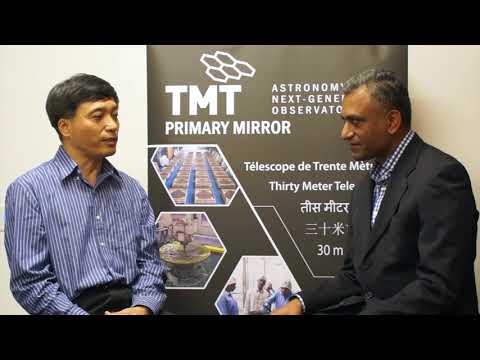


Ecco il prossimo della nostra intervista con il team TMT. Incontriamo con Tommaso Treu, Professore di astronomia all'Universit脿 della California di Los Angeles.

Here is the next of our interview with TMT team. Today we meet with Tommaso Treu, Professor of Astronomy at the University of California Los Angeles and Chair of the TMT Science Advisory Committee.

One of the most exciting developments in astronomy has been the detection of gravitational waves by The Laser Interferometer Gravitational Wave Observatory (LIGO). LIGO has detected the gravitational waves originating from the collisions of black holes and of neutron stars.

Presenting students the long voyage of the NASA鈥檚 Cassini spacecraft, Dr Ravinder Bhatia, TMT Project Manager Associate, talked about Saturn鈥檚 exploration and gave an outreach presentation on "Saturn's Rings and Moons" at Sierra Madre Elementary School on January 15, 2020.

Our Optics Group has been doing some testing recently. Click on the video below. You can see two strips of metal, separately attached to a circular piece of glass. Pull the strips apart. How hard can you pull before something breaks? And what on Earth does this have to do with building a telescope?
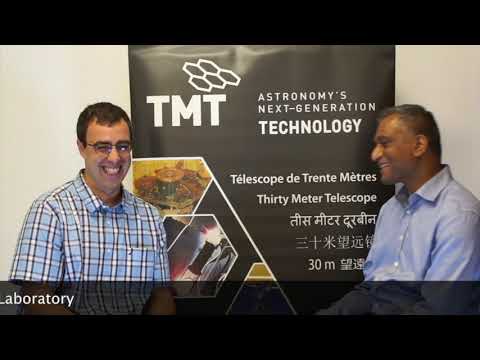
Here is the next of our interview series with the team of TMT. Today we meet with Dimitri Mawet, director of the Exoplanet Technology Laboratory of Caltech and lead researcher for MODHIS one of TMT first-light instrument. The Multi-Object Diffraction-limited High-Resolution Infrared Spectrograph (MODHIS) is a high-resolution spectrograph whose main science goal will be to characterize the atmosphere of exoplanets and search for the presence...

Voici un nouvel entretien avec l鈥櫭﹒uipe du TMT. Aujourd'hui, nous rencontrons Dimitri Mawet, directeur du laboratoire de Caltech sur les technologies li茅es 脿 la recherche des plan猫tes extra-solaires. Dimitri est aussi responsable de MODHIS, un des instruments de premi猫re lumi猫re pour TMT. Ce spectrographe infrarouge travaillera 脿 haute r茅solution spectrale et angulaire et aura pour principal objectif scientifique de caract茅riser et rechercher...

New Answers on the Horizon Black hole science asks many questions, some of which we鈥檝e talked about in this blog: Where do we find black holes? How 鈥渂ig鈥� are they? How old? And how do they grow and change over time? Now, in our final article about these cosmic leviathans, we'll look at how TMT will help advance our understanding. As we鈥檒l see, TMT will be an important part of the quest to learn more about these unfathomably massive, yet...

In this series of articles, we've discussed what we know about black holes鈥攈ow we can find them, how old they are, what their masses are. Now, we'll describe jets that we see coming from the center of some galaxies, where we think black holes are the source.

In previous articles in this series, we've looked at how we think black holes have formed, where they are, and how old they are. Now, let's look at how big they are.
Displaying posts 11 - 20 of 44 in total
